Recipe interview guide
How to record your grandmother's recipes: 15 questions to ask
To record your grandmother's recipes, ask about one dish at a time, use short open questions, and keep each session brief. Get her yes on the recording first. The 15 questions below cover the dish name, the method, andaaze se measures, substitutions, festival foods and where each recipe came from. They work as WhatsApp voice notes or in person. Label every file as you go.
- Ask about one dish per session. The Library of Congress guide suggests 20 to 25 questions for an hour 2, so 15 questions on one dish take about 20 to 30 minutes.
- Use short, open questions that start with how, what or who. Ask one thing at a time 12.
- Never record without her knowledge. Tell her who will hear it 12.
- Ask her to show quantities with her own katori and hands, and keep her words, andaaze se included.
- Name each file the day you record it, back it up, and type out only the parts you want to quote 12.
Before you ask the first question
The Smithsonian and the Library of Congress American Folklife Center have both published interview guides for people documenting their own families and communities. Both name food preparation and recipes as things worth documenting 12. Most of their advice fits Nani's kitchen.
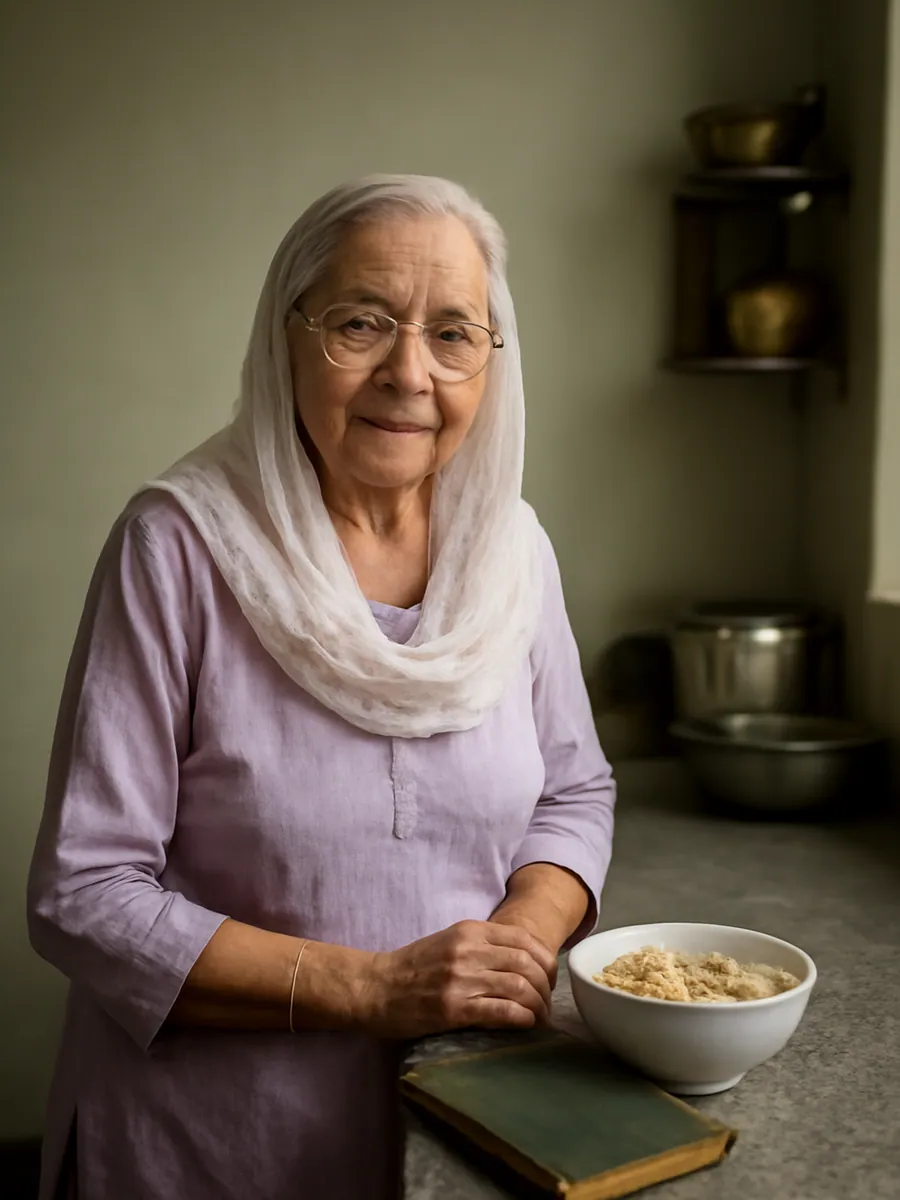
Before you start, pick one dish, so the session has a clear end. Tell her why you are asking and what will happen to the recording 1. And bring something she knows: her diary, her favourite kadhai, an old photograph of a family meal. Photographs and keepsakes stir memories and bring stories out 1.
The questions below are short on purpose. Questions starting with how, what or why get fuller answers than those starting with do or did 1. Avoid yes or no questions, leading questions and multi-part questions, because a person can only answer one thing at a time 2. For follow-ups, try "Can you give me an example?" or "What are the steps in doing that?" 2.
Questions 1 to 7: the dish and how it is made
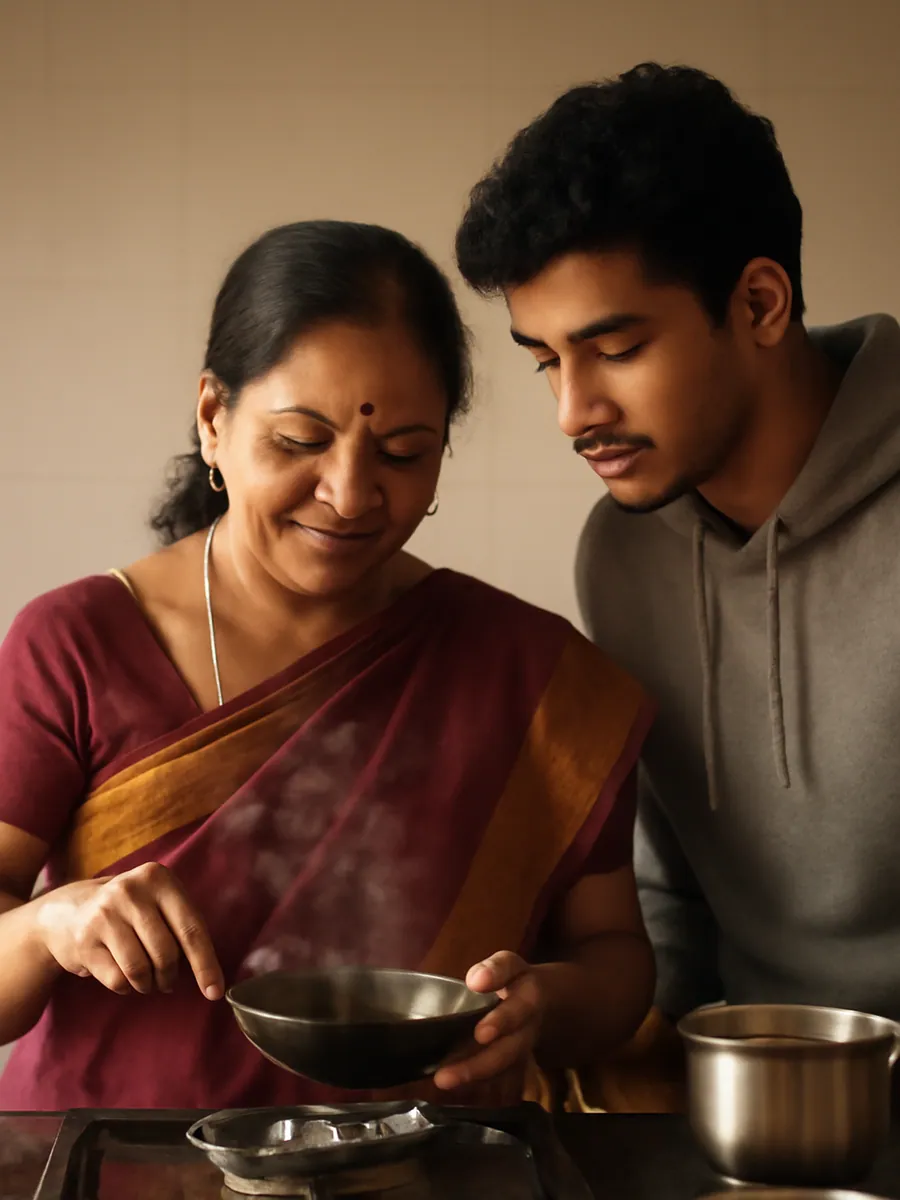
Start with the easy ones. Ask question 4 in the kitchen if you can, while she cooks. For question 5, listen for what she sees, smells and hears: the tadka crackling, the dough no longer sticking.
| # | Ask about | English | Hindi |
|---|---|---|---|
| 1 | The name | What do you call this dish at home? | Ghar mein aap is dish ko kya kehti hain? |
| 2 | Who asks for it | Who asks for this dish most often? | Is dish ki farmaish ghar mein sabse zyada kaun karta hai? |
| 3 | When it is made | When do you usually make it? | Yeh dish aap aam taur par kab banati hain? |
| 4 | The method | Tell me how you make it, as if I am standing next to you. | Samjhaiye jaise main aapke bagal mein khadi hoon. Yeh kaise banta hai? |
| 5 | Signs it is ready | How do you know it is ready? | Aapko kaise pata chalta hai ki yeh taiyaar hai? |
| 6 | Tools | Which pot, pan or tool do you use for it? | Iske liye aap kaunsa bartan ya aujaar use karti hain? |
| 7 | The common mistake | What is the one thing people often get wrong with this dish? | Is dish mein log aksar kya galti kar dete hain? |
Questions 8 to 10: andaaze se, substitutions and changes
This is where most family recipes lose their detail. "Thoda sa" means something precise to her and nothing to you. After question 8, ask her to show you: a pinch, a spoon, a katori or a fistful. Better still, ask her to fill her own katori with water and pour it into a measuring cup. A katori is not a standard unit, and sizes differ from home to home. See writing down andaaze se recipes and katori to cups conversion for more.
For question 10, the Smithsonian guide suggests asking how and why ingredients have changed over time 1. A recipe that now uses a mixer is still hers. Note what changed.
| # | Ask about | English | Hindi |
|---|---|---|---|
| 8 | Vague measures | When you say "thoda sa", how much is that? | Aap jab "thoda sa" kehti hain, toh woh kitna hota hai? |
| 9 | Substitutions | What do you use when an ingredient is missing at home? | Ghar mein koi cheez na ho, toh aap uski jagah kya daalti hain? |
| 10 | What has changed | What has changed in this recipe over the years? | Saalon mein is recipe mein kya badla hai? |
Questions 11 to 15: festival foods and where the recipe came from
Festival foods carry a lot of memory, so let her lead. Practice varies by family, region and community, so record what her family does. You do not need dates or timings. If she mentions a home remedy, write it down as a traditional family note, not medical advice.
Questions 13 to 15 trace the recipe back. Stay with the dish. Her wider life story is a separate conversation, covered in questions to ask your grandparents.
| # | Ask about | English | Hindi |
|---|---|---|---|
| 11 | Festival foods | Which dishes does your family make for which festival or season? | Aapke ghar mein kaunsa tyohaar kaunse pakwan ke saath manaya jaata hai? |
| 12 | Making ahead | What do you prepare days before the festival? | Tyohaar se kai din pehle aap kya taiyaar karna shuru kar deti hain? |
| 13 | Who taught her | Who taught you this recipe? | Yeh recipe aapko kisne sikhayi? |
| 14 | How she learned | How did you first learn to make it? | Aapne ise pehli baar banana kaise seekha? |
| 15 | Where it came from | Where did this recipe come from, before it reached your kitchen? | Yeh recipe aapki rasoi tak pahunchne se pehle kahan se aayi? |
Ask first, and make it easy to say no
Do not record anyone without their knowledge 12. Tell her who will hear the recording: the family group, one cousin abroad, or a printed book. Explain the purpose and what will happen to the recordings 1.
Begin your first recording by asking, "Can I record this, and may I share it with the family?" and let her say yes on the recording. The Library of Congress guide uses signed release forms for projects that will be published, and notes that an interviewee can always decline to sign 2. For a family book, a spoken yes plus her confirmation after she has heard the finished pages works well.
Tell her she can skip any question and ask you to delete any note. If she tires, stop and book another session 1. Afterwards, thank her and give her a copy of the recording 1.
By WhatsApp voice note or in person
Voice notes suit grandmothers who are far away or find a long sit-down tiring. In person is better for method, because you can see her hands.
- WhatsApp: send one question at a time and ask her to answer by voice, in the language she cooks in. Answers of about a minute are easier than one long monologue. She can pause and resume while recording, and listen back before sending 3.
- WhatsApp, after: do not leave the notes only in the chat. Forward them to one folder you control and label them the same day.
- In person, set-up: record a minute first and play it back. Say her name, the date, the place and the dish aloud as a label 1. Switch off the TV and keep dishes from clattering 1.
- In person, during: keep recording instead of stopping and starting 1. Jot follow-ups on paper rather than interrupting 2. Pauses are fine, so give her time to think 2.
- Photograph the process: a camera is especially useful for a favourite family recipe being made 1. Note the dish and date for each photo. For her handwritten pages, see how to photograph handwritten recipes.
- Cook along: one Smithsonian example follows a 95-year-old cook from choosing the coconut to serving her cake, and the family later printed a 43-page booklet 1.
Label, back up and transcribe
Name your files on the day you record them. The Library of Congress guide suggests words for the collection and topic plus a number for the sequence, renamed each day before you back up 2. For example: Nani_Rajma_01_2026-11-02. Keep a second copy elsewhere, such as an external drive 2. Note her name, the place and the date 1.
Make a short log, a topic-by-topic list with timestamps, in a notes app or spreadsheet 12. You need not type every word. Log the whole recording and transcribe word for word only the parts you might quote 1. Voice typing can give a rough first draft, but check it against the recording.
Keep her words. Write "andaaze se" as she said it, and put any conversion in brackets as approximate. Mark each recipe as a family recipe, not a tested one.
What to do with the recordings
The Smithsonian guide lists a family recipe book, with the stories around each dish, as one way to share what you collect 1. Our guide to making a family recipe book shows how.
Chalk Art can lay this out as a book for you: make one here.
Questions
How many questions should I ask in one sitting?
Stay with one dish and the 15 questions above, about 20 to 30 minutes. The Library of Congress guide suggests 20 to 25 questions for an hour . Stop earlier if she tires .
What if she cannot explain a quantity?
Ask her to show it with her hands, or to measure with her own katori into a measuring cup. Write down both her word and the measure.
Can she answer in Hindi or another language?
Yes. Let her answer in the language she cooks in and keep her words as they are. Add an English line underneath if the family needs it.
Do I need her written permission?
Get her clear yes on the recording and tell her who will hear it . A signed release is the stronger record for anything published beyond the family . This is general information, not legal advice.
Sources
- Smithsonian Folklife and Oral History Interview Guide (special edition), Smithsonian Center for Folklife and Cultural Heritage, with the Smithsonian Institution Traveling Exhibition Service. Accessed 31 October 2026.
- Folklife and Fieldwork: An Introduction to Cultural Documentation, Fourth Edition, American Folklife Center, Library of Congress. Accessed 31 October 2026.
- We're making voice messages even better, WhatsApp Blog. Accessed 31 October 2026.