Recipe keeping
Andaaze se: how to write down a recipe that was never measured
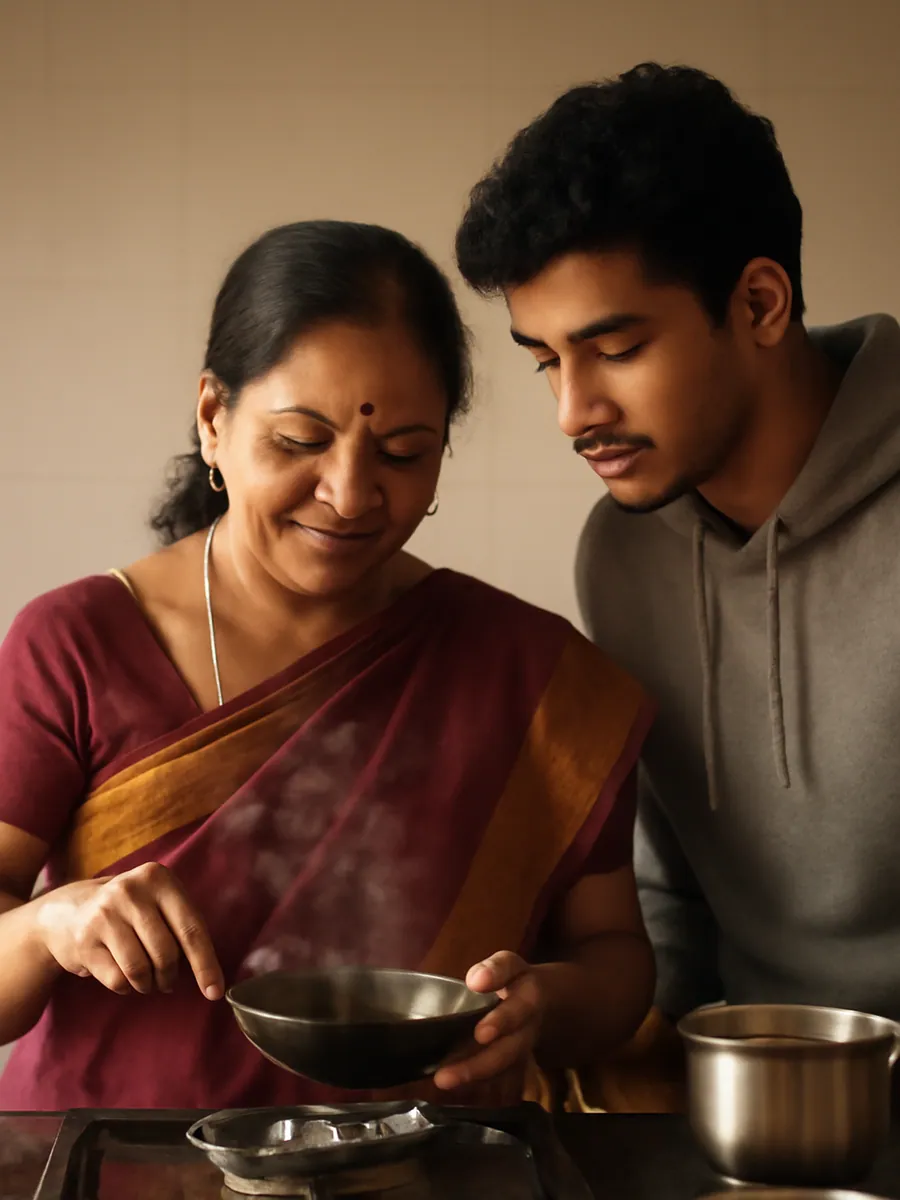
To write down an "andaaze se" recipe, cook beside the cook and measure what she does instead of asking her to guess. Weigh each ingredient before and after she pours it, note the colour, smell and sound that tell her a step is done, and record timings and the pan she uses. Then write it in standard form: ingredients in order of use with exact amounts, then short numbered steps with cues and pan sizes 14. Keep her own phrases in a separate line, so the recipe works for a stranger and still sounds like her.
- Do not ask her for quantities. Watch her cook and measure what she actually uses, ideally on a kitchen scale.
- Weigh the container before and after each pour. The difference is her "thoda sa" or "andaaze se".
- Her cues (colour, smell, sound, texture) are the real recipe. Write them next to the measured amounts, not instead of them 3.
- Standard form puts ingredients first, in order of use, then numbered steps with pan size, time and yield 14.
- Cook the dish a second time from your draft, with her watching, before you call it finished.
Why asking her for quantities does not work
If you ask a cook who works by feel how much salt goes in, she will usually say "andaaze se" and smile. She is not hiding anything. Her hand has learned the amount, and her mind has never turned it into a number.
When pushed, people guess, and the guess is often wrong. A recipe built on guesses fails the first time someone else cooks it, and then the family decides the dish cannot be written down. It can. You just have to measure her instead of asking her.
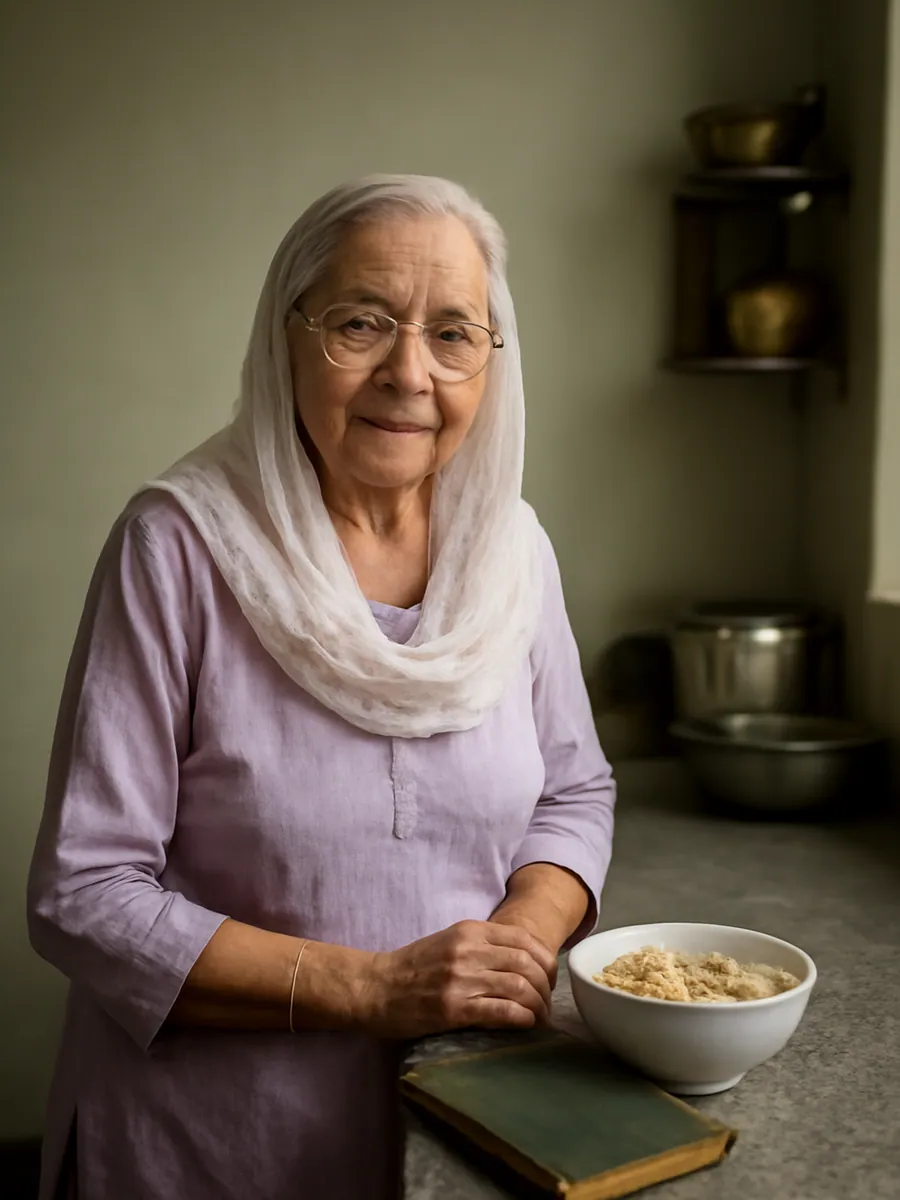
This article uses one example, a fictional one: Rukmini Ammamma's tomato pappu from Guntur. Swap in your own dish, your own nani or maa. The method is the same.
Before you start: what to keep on the counter
You do not need special equipment. Ask her first, and tell her why you are doing this. She can stop you at any point, and she decides whether a voice note or photo is kept.
- A kitchen scale that shows grams, with a tare button, and a small notes app or notebook beside it.
- A pen and paper, even if you also type notes on your phone.
- A phone on a stand or a steady shelf, to record sound and video of the pan. Sound matters more than you think.
- Her own katori, spoons and tumbler. Do not swap them for yours.
- A measuring jug in millilitres, and a few small bowls for pouring things out.
- A ruler or tape, for the pan, kadhai or cooker.
Measure what she pours, not what she says
The simplest trick is to weigh before and after. Put the masala dabba or the flour bowl on the scale and note the weight. Let her take her usual pinch or handful and add it to the pot. Put the container back on the scale and note the new weight. The difference is her measure.
Do this for every ingredient she does not measure. For wet things like oil, ghee or water, let her pour into a small bowl on the scale first, then into the pan. Do it for her "thoda sa" too, because that is often the amount that decides how the dish tastes.
Weight is the safer way to record dry ingredients. A cup of flour can hold as little as about 120 g or as much as about 160 g depending on how tightly it is packed 2. A katori has the same problem. If she likes to use one, write which katori it is and fill it with water to find its size in millilitres. For conversions, see our note on katori to cups.
| She says | What you do | What you write |
|---|---|---|
| "Andaaze se namak" | Weigh the salt container before and after her pinch. | 1 tsp salt (about 6 g). Her phrase: "andaaze se". |
| "Ek katori dal" | Fill her katori to her usual level, then weigh the dal and note the katori's water volume. | 1 steel katori toor dal (150 ml, about 125 g). |
| "Thoda sa tel" | Let her pour into a bowl on the scale, then into the pan. | 2 tbsp oil (about 25 g). |
| "Aata narm gundh lo" | Weigh the flour and the water she adds, a little at a time. | 2 cups flour (240 g) and about 130 ml water, added gradually. |
| "Jab tak masala bhun jaye" | Time it and film it. Note the colour and the sound. | Cook 6 to 8 minutes until the oil separates at the edges. |
Write down her cues: colour, smell, sound and texture
Cooks who work by feel rarely watch a clock. They watch the pan. A recipe that says "cook for 5 minutes" misses the point, because the minutes are only a rough guess at what she sees and hears. Good recipe guidance asks writers to describe signs of readiness such as a colour change, a texture or a sound 3.
Ask her "how do you know it is ready?" at every step and write the answer word for word. Then add what the clock showed. Together they give a stranger two ways to check.
Typical cues to listen for: the oil leaving the sides of the masala, mustard seeds popping and then going quiet, the smell of roasted besan turning nutty, a dough that stops sticking to the bowl, and the whistle count of her pressure cooker.
- Record the pan or pot: kadhai, tawa, cooker, and its size across the top (for example, a 24 cm kadhai). Pan size changes how fast things cook, so recipe guidance asks for it 1.
- Record the flame: low, medium or high, and whether she changes it during the step.
- Note the heat of the oil when she adds seeds. "Seeds sizzle at once when dropped in" is a cue anyone can follow.
- Note resting times that she does without thinking, such as dough resting under a cloth.
- Add a time estimate to each step and a total at the end. Writers are advised to show both active and total time 4.
Write it in standard form
Once you have numbers and cues, put them in the shape most cookbooks use. The standard form lists the ingredients first and then the method. Ingredients go in the order they are used, with exact amounts and any preparation, and the method is brief and clear with descriptive cues and pan sizes. The recipe also states how much it makes 1.
A few small conventions help a stranger follow along. Use one system of units and do not switch halfway 3. Write the method as numbered steps, and start a new step when the vessel or the ingredient group changes 4. Small amounts are usually written as fractions of a teaspoon, though herbs and spices can stay as a pinch 4.
Here is how a short piece of Ammamma's tomato pappu might look.
- Makes: 4 servings. Active time: 20 minutes. Total time: 45 minutes.
- Ingredients: 1 steel katori toor dal (150 ml, about 125 g), washed; 2 tomatoes, chopped; 1 tsp turmeric; 2 tbsp oil; 1 tsp mustard seeds; 8 curry leaves; salt (about 1 tsp).
- Step 1. In a 3-litre cooker, add the dal, tomatoes, turmeric and 3 katoris of water. Pressure cook for 4 whistles on medium heat (about 15 minutes).
- Step 2. Heat the oil in a small pan. Add the mustard seeds. When they sizzle at once and then go quiet (about 1 minute), add the curry leaves.
- Step 3. Pour the tadka into the dal and add salt.
- In Ammamma's words, translated from Telugu: "Mash the dal until the water and the dal no longer look separate."
Keep her phrases, but in their own place
Do not replace "andaaze se" with a number and move on. Her words carry the dish. Keep the exact measure in the ingredient line and put her phrase beside it, or in a short line under the step. Readers get a working recipe and a voice at the same time.
Quote her in her language, then give a short English meaning if the reader may need it. If she uses a nickname for a technique or an ingredient, keep it and explain it once. Add a short note at the top: who taught her, when she makes it, who always asks for it. These notes are often what a family treasures most.
If she is happy to be recorded, keep the original voice notes and photographs of her handwriting. Number them to match the recipe so they can be linked later.
Cook it again from your draft
Print the draft and annotate it while you cook, and read it aloud afterwards to catch clumsy wording 3. Better still, cook the dish a second time following only the page, with her watching and correcting. Her "yeh thoda zyada hai" will tell you where a number is off.
Small gaps in weight are usually not a problem. One baking company notes that being within about 5 g of the target typically will not change the result for flour 2. For spices and salt, taste and adjust your range.
Mark the recipe as tested and note the date. If you changed something because she asked, say so.
When you have a few recipes
Once five or six recipes are written this way, they are ready to go into a family cookbook. Our guide on how to make a family recipe book walks through the order and the layout, and photographing handwritten recipes covers the original pages.
Chalk Art can lay this out as a book for you: make one here.
Questions
What does andaaze se mean in a recipe?
"Andaaze se" means "by estimate" or "by feel". The cook adds an amount she judges by eye, hand and experience instead of a measuring spoon. To write the recipe down, you measure what she actually uses so a stranger can repeat it.
How do I measure what my mother pours without asking her to change how she cooks?
Weigh the container before and after she takes her usual amount. She cooks as she always does, and the difference on the scale is her measure. Do it for each ingredient, and repeat for a second batch if you can.
Should I use grams or cups for an Indian family recipe?
Grams are more reliable for dry ingredients, because a cup of flour can vary by tens of grams depending on how it is packed . You can add cups or katori alongside, if the family uses them, as long as you say which katori it is.
How do I record a cue like "until the oil separates"?
Write her words exactly, add the time it took on your clock, and note what the pan looks and sounds like. Recipe guidance recommends describing signs such as colour, texture or sound for this reason . A short video helps.
Do I need her permission to record her cooking?
Yes. Tell her what you are recording, who will see it and why. If the recipe will go into a book that others will read, let her check the draft and say yes before printing.
Sources
- Step 3: Food Selection (Favorite Foods Revue Booklet), University of Nebraska-Lincoln, Nebraska Extension in Burt County. Accessed 31 October 2026.
- How to measure flour, King Arthur Baking Company. Accessed 31 October 2026.
- How to write a good recipe: 23 top tips, olive magazine. Accessed 31 October 2026.
- Recipe Style Guide, Guiding Stars Licensing Company. Accessed 31 October 2026.