Veetu Saapadu: Amma's Recipes for Vignesh in Manchester
For Vignesh, from Amma (Vasanthi) and Appa, Coimbatore, packed before his September flight. A fictional family.
Ghar se door cookbook
The bags are packed, the masala dabba is wrapped in a dupatta, and there is one worry...
For Vignesh, from Amma (Vasanthi) and Appa, Coimbatore, packed before his September flight. A fictional family.
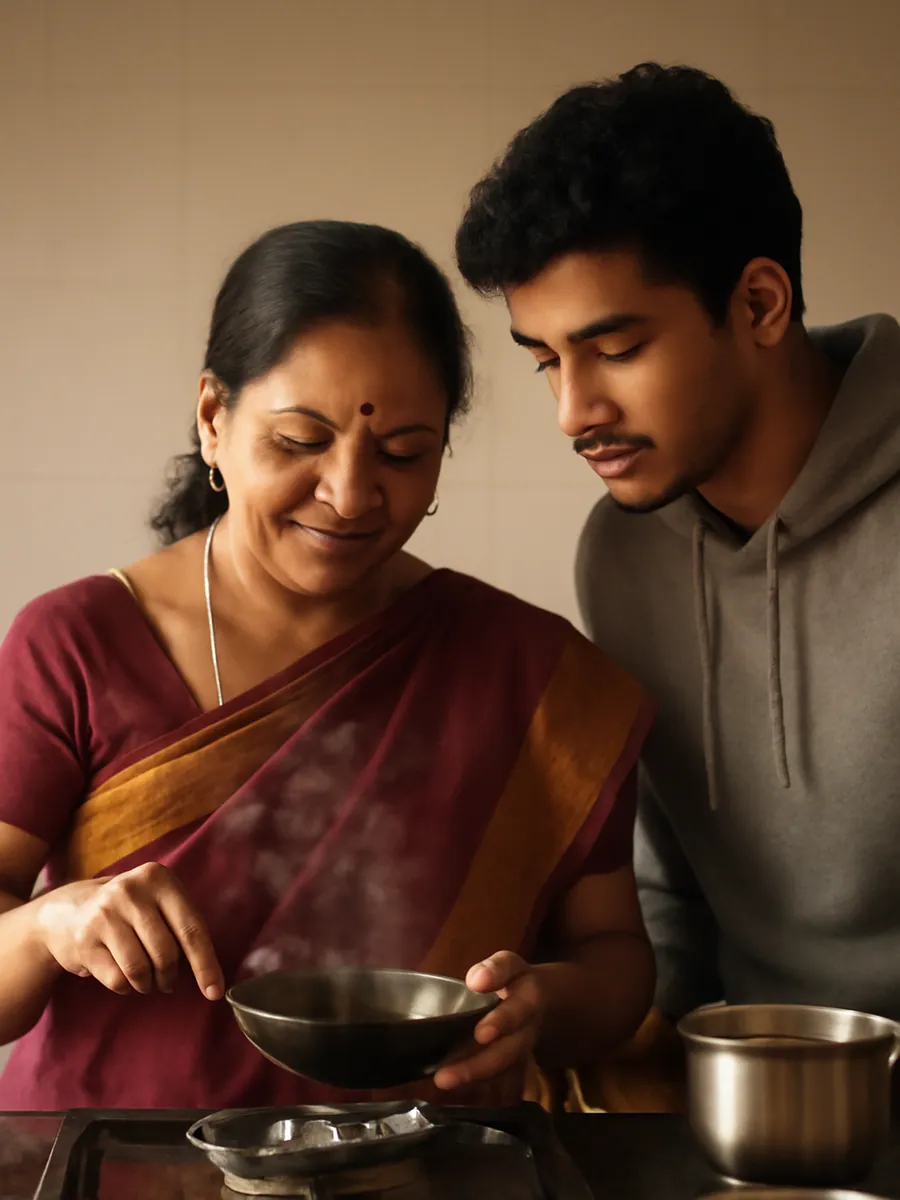


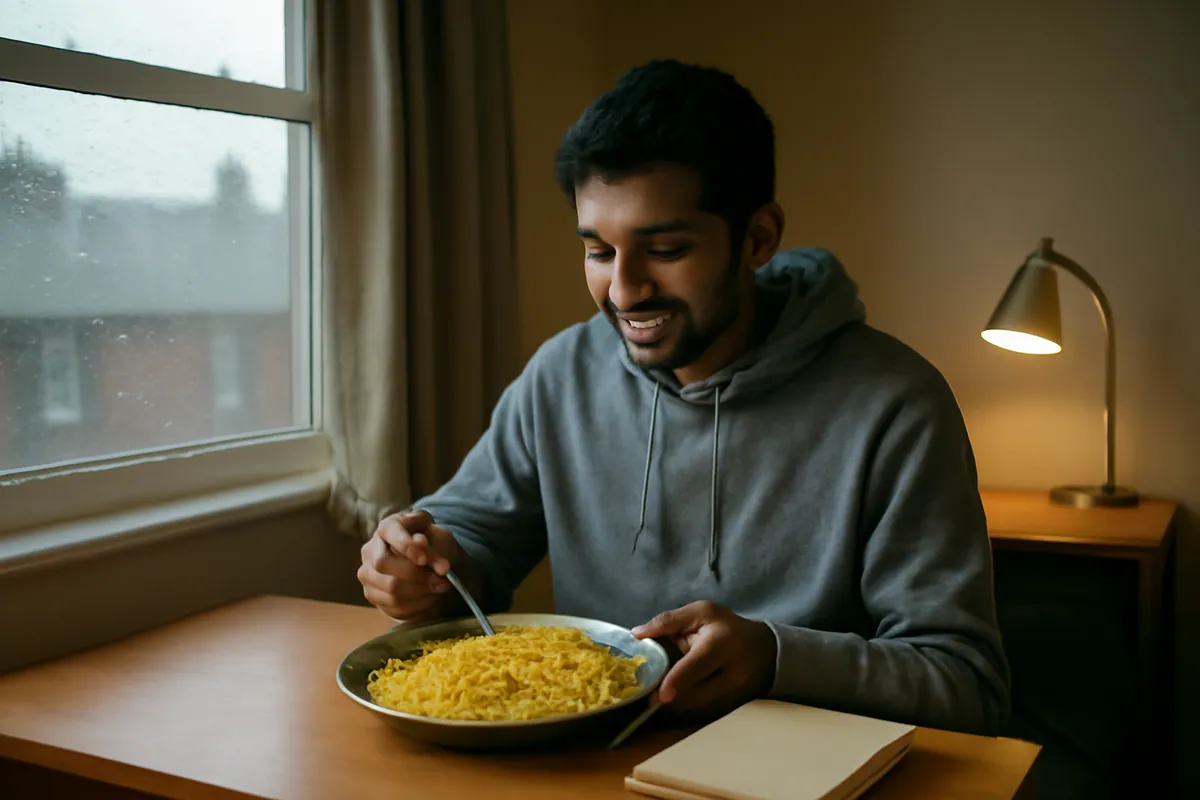
You photograph the recipe pages and answer a few short questions, including the country they are moving to and what they eat. AI reads the handwriting, keeps every andaaze se as written, simplifies the steps for a small kitchen and suggests swaps for ingredients that are hard to find there. Every swap is clearly marked as a suggestion. No design work, no editor.
Printed copies are paid, one for the suitcase and one for home.
Your child's name and the city they are moving to, over a dish photo or a photo of the family kitchen. You choose from three title options, such as Ghar Ka Swaad: Recipes for Aarav in Toronto.
A short foreword written from your one-line answer about what this kitchen means. Type it or hold to record. You read and confirm it in the preview.
Rice, dal, a simple sabzi, chai, poha or upma, and an egg bhurji if they eat egg. Steps are simplified for a single induction plate or a shared kitchen, with one pot wherever the recipe allows.
The photo of the original handwritten page sits first, so the handwriting is the record. Beside it is a typed version marked AI-read. Measures like ek mutthi or 2 katori stay word for word, and any cups or grams appear only in brackets marked approx. If something in the handwriting is unclear, you get a tap-to-choose question in the preview, never a page to proofread.
For the destination country, AI suggests substitutes for ingredients that may be hard to find, such as a different flour or a frozen alternative to fresh curry leaves. Each swap is printed in a marked box as a suggestion, never in place of the original, and it follows the diet you chose. Check it before cooking.
One or two dishes for the first Diwali, Eid, Onam or Lohri away, if you want them. Customs and festival food vary by family, region and community, so the page uses only the dishes and words you give us.
What goes in the dabba and what each spice is called in English, for example hing is asafoetida and methi is fenugreek. Useful when shopping in a new country. If you add a family remedy such as haldi doodh, it is printed as a traditional family note, not medical advice.
Making the book and saving the PDF is free. Printing is optional and paid, and we confirm the price and delivery date by email before you pay.
Photo books are laid out on your device and the photos never leave it. For illustrated books, up to three photos are used once to draw the character and then deleted. See privacy.
You tell us the destination country and the diet. AI suggests a substitute where an ingredient may be hard to find there, and prints it in a marked box beside the original recipe, never in its place. Swaps are suggestions, not tested recipes, so your child should check labels and taste as they go.
Taking clear photos of the recipe pages now saves time later; our guide to photographing handwritten recipes shows how.
These are family recipes, not test-kitchen recipes. Every book carries an allergen note, and suggested swaps are flagged as unchecked. If your child has an allergy, read every recipe and swap in the preview and remove anything that does not suit them.