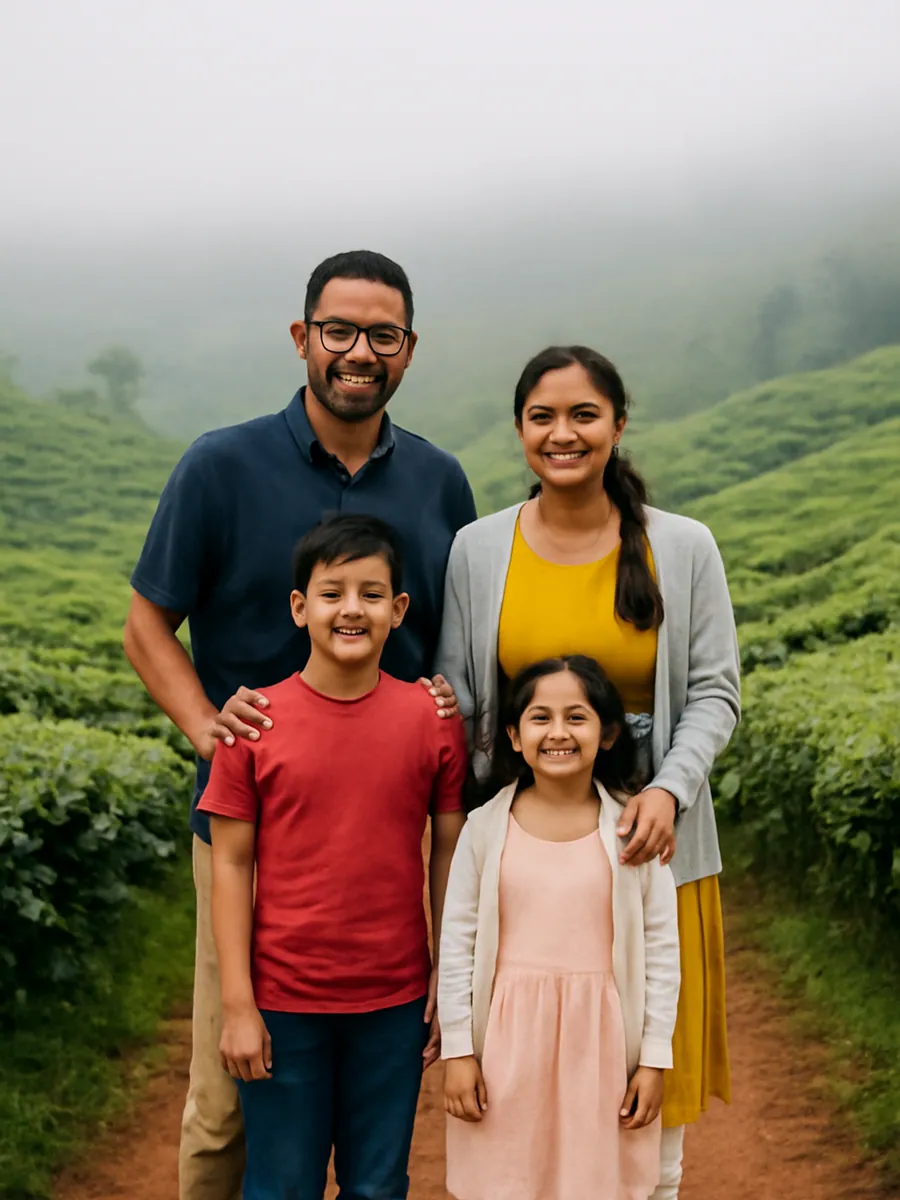
Honeymoon book ideas
Honeymoon photo book ideas, and what to write on the first page
The easiest way to plan a honeymoon photo book is to follow the trip itself. Open with a short dedication, give the journey and arrival a chapter, then one spread for each day or each place, a few pages about the destination, a page of small rituals and firsts, and a quiet closing page. Pick one strong photo per spread and write one line beside it. Below are page ideas, a sample plan for a 24-page book, original first-page dedications in English, Hindi and Hinglish, and cover titles you can adapt.
- Build the book around the trip in order: journey, arrival, each day, the place, small rituals, then a closing page.
- Give each day one spread with one hero photo and one line of text.
- The first page needs only three things: who it is for, one honest line, and the place and month.
- Print the name of your song of the trip, not the lyrics, and write your own line instead.
- Crop or hide the barcode and booking code on any boarding pass photo before the book is shared.
Start with the shape of the trip
A honeymoon book is easiest to plan, and to read years later, when it follows the trip in the order you lived it. You do not need a clever theme. Days, places and a few small moments are enough.
If you went to more than one place, say Srinagar and then Gulmarg, or Kochi and then Munnar, use the places as chapters and the days inside them. If you stayed in one resort for a week, use the days as chapters and let the destination have its own pages near the start.
Here is a simple plan for a 24-page book. Stretch the day pages for a longer trip or merge two quiet days into one spread.
| Pages | What goes here | Photos to pick |
|---|---|---|
| 1 | First page: dedication, names, place and month | None, or one small photo of the two of you |
| 2 to 3 | The journey: leaving home, the station or airport, the first view | 3 to 5, including one candid |
| 4 to 5 | Arrival: the room, the first meal, the first walk | 4 to 6 |
| 6 to 7 | The destination: a simple route map, the landscape, the local food | 4 to 6, mostly wide shots |
| 8 to 17 | Day by day: one spread for each day | 1 hero photo and 3 to 4 supporting photos per spread |
| 18 to 19 | Small rituals and firsts | 6 to 9 small photos |
| 20 to 21 | The best day, or the one that went wrong | 1 large photo and a short story |
| 22 to 23 | The last evening and the journey home | 3 to 5 |
| 24 | Closing page: a note to each other or a list of what you want to do next | None, or one quiet photo |
Ideas for the journey and arrival pages
The first photos of a honeymoon are rarely the best ones, but they set the mood. Look for the in-between moments: bags at the door, the two of you half asleep at the gate, the first glimpse of the hills or the sea from the window.
Tickets and boarding passes make good page details, with one caution. A boarding pass barcode can hold more than what is printed on it, and the booking code with your surname can be enough for someone to open your reservation online 1. Before the book goes on WhatsApp, crop the pass to the route and date, or cover the barcode and booking code fully.
- The leaving photo. Shoes by the door, a packed suitcase, Mummy waving from the gate.
- The first view. The window seat over the mountains, or the first sight of the backwaters from the car.
- The room. One photo from the doorway, before you unpack anything.
- The first meal. What you ordered, and who finished whose plate.
Day by day: one spread for each day
Give each day a two-page spread. Put one hero photo large on one side, and three or four smaller photos on the other. Add a short day heading, such as "Day 3: Pahalgam, and the horse that would not move", and one or two lines about what happened. That is enough to bring the whole day back.
Not every day needs to be busy. A rest day by the pool or a rainy afternoon in the room can have its own spread with fewer photos. These quiet pages often become the ones you linger on.
Check the dates before you sort. Google Photos files photos taken before 4 AM under the previous day 5, so an early sunrise trek or a late-night arrival may land on the wrong page. If one phone kept India time on a trip abroad, select its photos on a computer and use "Shift dates & times" to move them together 5.
Give the destination its own pages
A honeymoon book is about the two of you, but the place is the third character. Two pages about the destination itself, away from your faces, make the book feel like a trip and not a selfie roll.
- A route map. Draw or trace your route, with the stops in order and the dates beside them.
- The landscape. Pick two or three wide shots: the shikara at sunrise, the tea gardens, the beach at low tide.
- The food. One page of dishes you will try to cook at home and probably never get right.
- Words you learned. A few local words or phrases you picked up, written the way you said them.
- The people. The driver who played old songs all the way, the cook who packed lunch. Take their photo only if they are happy for you to.
Small rituals, firsts and the song of the trip
Every trip develops tiny habits within two or three days: chai on the balcony at the same hour, a walk after dinner, the one of you who always carried the water bottle. These rituals are the details that fade first, so give them a page of their own.
If a song played through your trip, print the song title and a line in your own words about when it played. Under Indian copyright law the words of a song are a separate work from the music 3, and original literary works are protected 3, so the title plus your own line is the safer choice. This is general information, not legal advice.
Photograph paper keepsakes, such as a ferry ticket or a pressed flower, flat in daylight for the book. If you also make a handmade album, the Library of Congress suggests acid-free, lignin-free paper for pages and mounts, and no self-adhesive tape, staples or paper clips 2.
- Our morning chai: a grid of the same cup, a different view each day.
- First as a married couple: the first joint bill, the first wrong turn, the first time someone called you "Mr and Mrs".
- The funny disaster: the missed ferry, the rain on the one day you planned a picnic, the lost charger.
What to write on the first page
The first page of a honeymoon book needs only three things: who it is for, one honest line, and the place and month below it. Keep it short. A line you would actually say out loud ages better than a borrowed quote.
A nice approach is to write one line each, separately, and read them together only when the book arrives. These original examples are for you to use as they are or change.
- "For us, before the routine sets in. Srinagar, February."
- "Seven days, two suitcases, one very patient driver. For Ritika, from Sameer."
- "You held the map upside down and we still found the sea. For Nazia."
- "To the start of everything. Kochi to Munnar, December."
- "Read this on a bad day and remember we were this happy."
- In Hindi: "हमारे पहले सफ़र के नाम, जो अभी बस शुरू हुआ है।"
- In Hindi: "तुम्हारे साथ हर रास्ता छोटा लगा।"
- In Hinglish: "Pehli trip, pehli ladai, pehli sunrise. Sab kuch saath."
- For the closing page: "Places we still owe each other: Hampi, Ladakh, and that cafe we never found."
Cover title ideas
Names, a place and a length of time make a title that still reads well in twenty years. These fictional examples show a few styles. For design ideas beyond the title, see travel photo book cover ideas.
- Lalitha & Karthik: Nine Days in the Andamans
- Simran & Harjot: Shimla, Snow and Not Enough Sweaters
- Ananya & Debojit: Our First Trip Together
- Priya & Joel: From Goa, With Love
- Mrunal & Siddharth: Two Weeks, Three Islands
- Hamara Pehla Safar: Tanvi & Aditya, Udaipur
Choosing photos and finishing the book
Most honeymoons produce far more photos than a book can hold, spread across two phones. Collect both sets in one place first. Google Photos lets you search by places and things in your photos, and turning on camera location helps that search 4, so searching the destination name pulls up most of the trip. Our guide on turning Google Photos into a printed book covers picking in detail.
When you choose, check that both of you appear about equally, and keep a few photos where neither of you is posing. Keep one photo per moment, and leave out anything you would not want parents to see when they pick the book up. Our trip photo captions list has lines you can adapt.
Chalk Art can lay this out as a book for you: make one here.
Questions
How many photos should go in a honeymoon photo book?
For a 24-page book, around 60 to 90 photos works well: one large photo and three or four smaller ones on most spreads, with fewer on the first and last pages. A longer trip can go to 32 or 40 pages.
What should I write on the first page of a honeymoon photo book?
Write who it is for, one honest line in your own words, and the place and month. Writing one line each and reading them together later is a nice touch.
Can I put a photo of our boarding passes in the book?
Yes, but crop out or cover the barcode and booking code first, especially if the book will be shared online. The barcode can hold personal booking details.
Can I print our song's lyrics in the book?
Song lyrics are protected as a work separate from the music under Indian copyright law, so the safer choice is to print the song title and write your own line about it. This is general information, not legal advice.
Should the honeymoon book be in English or Hindi?
Use whatever language you speak to each other. Hinglish captions with a Hindi line on the first page work well if the book will also be read by parents or grandparents.
Sources
- Why it's still a bad idea to post or trash your airline boarding pass, Krebs on Security. Accessed 31 October 2026.
- Preservation measures for scrapbooks and albums, Library of Congress. Accessed 31 October 2026.
- The Copyright Act, 1957 (as amended up to Act No. 7 of 2017), WIPO Lex, World Intellectual Property Organization. Accessed 31 October 2026.
- Search by people, things & places in your photos, Google Photos Help, Google. Accessed 31 October 2026.
- Edit your photos (computer), Google Photos Help, Google. Accessed 31 October 2026.